
by Kimberly Eugene, 05/04/2023
Search engine marketing (SEM) and search engine optimization (SEO) tools are being used increasingly by marketers to reach their customers due to their ability to connect consumers to what they search for with what marketers are looking to promote. The two main tactics within SEM are pay-per-click (PPC) advertising and SEO, and finding the balance between both tactics is important for any successful digital marketing campaign.
Let’s create an example of a search engine marketing campaign for Starbucks’ brand of thermal traveling mugs, also known as “tumblers”, by using the appropriate PPC and SEO strategies to meet organizational goals.

CaMpaign Objectives
In this example, we are marketing Starbucks’ brand of thermal travel mugs, also known as tumblers. We have a marketing media budget of $50,000 and we are aiming to sell 10,000 units in 6 months using PPC and SEO strategies. Our objective is to spend no more than $5 per unit in acquisition costs. A key piece of information to note for this campaign is that our current click-through rate (CTR) is at 1%, and so is our ad conversion rate (CVR), while our bounce rate is at a whopping 50%. With over 27,000 page views in our first week and 27,750 page views in the second, this doesn’t indicate a problem with ad visibility but rather that the quality of the content is not relevant or relatable to our audience. We can fix this with SEO and PPC.
Keyword Research
Before officially creating a PPC campaign and bidding on keywords it is important to first have a general idea of what consumers are searching for in relation to your product and/or brand. This will provide insight into which keywords are worth capitalizing on in our PPC campaign as it will also help to identify negative keywords that we may consider excluding from being associated with the campaign, which can be key to a highly successful campaign.
A good start would be to use a keyword generator website such as kparser.com or spyfu.com to identify various keywords and phrases searched by consumers in relation to the brand’s tumbler product. These websites will deliver real-time data for keyword searches, negative keywords to consider excluding from a campaign, and even the cost-per-click (CPC), a very important metric in understanding the worth of keywords in PPC advertisements.
A keyword search for “Starbucks tumbler” in the website’s search bar will initiate the real-time data retrieval process and will reveal related keywords, such as “cup”, “mug”, and “stainless steel” that customers also use when searching for Starbucks’ drinkware (See kparser.com website in figure 1.1 shown below). These may be helpful keywords for search engine optimization.
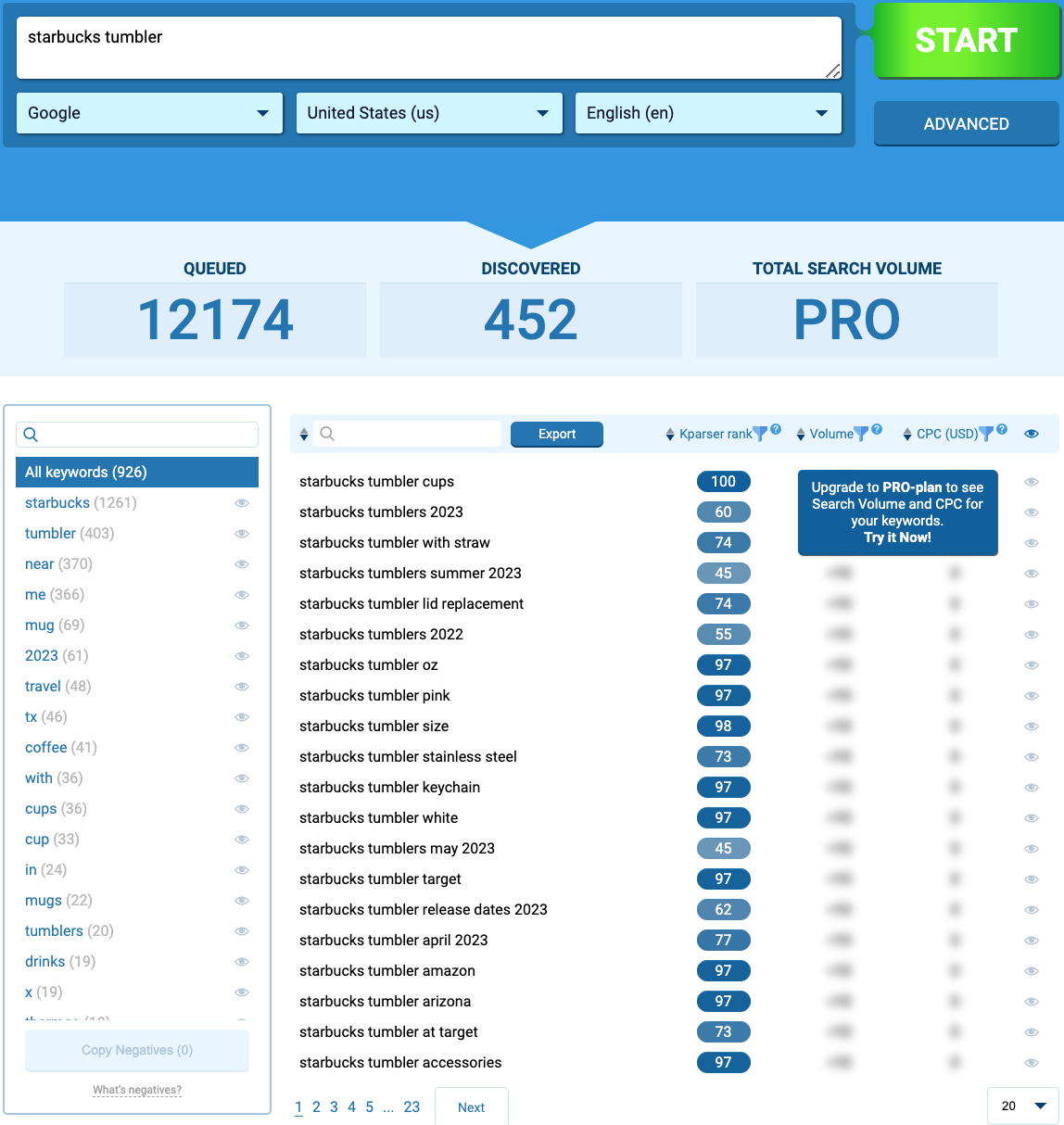
Figure 1.1
These keywords indicate opportunities for optimizing text ads and website content so that they include such keywords in order to improve relevancy and positioning on search engine results pages. It is also important to beware of negative keywords that marketers should exclude from their campaigns in order to help maintain focus on only the keywords that matter to their customers.
Some examples of negative keywords for our Starbucks tumbler campaign would be things such as “coffee” or “drinks” that may lead to the company’s drink menu. Better targeting can put your ad in front of interested users and increase your return on investment (ROI).
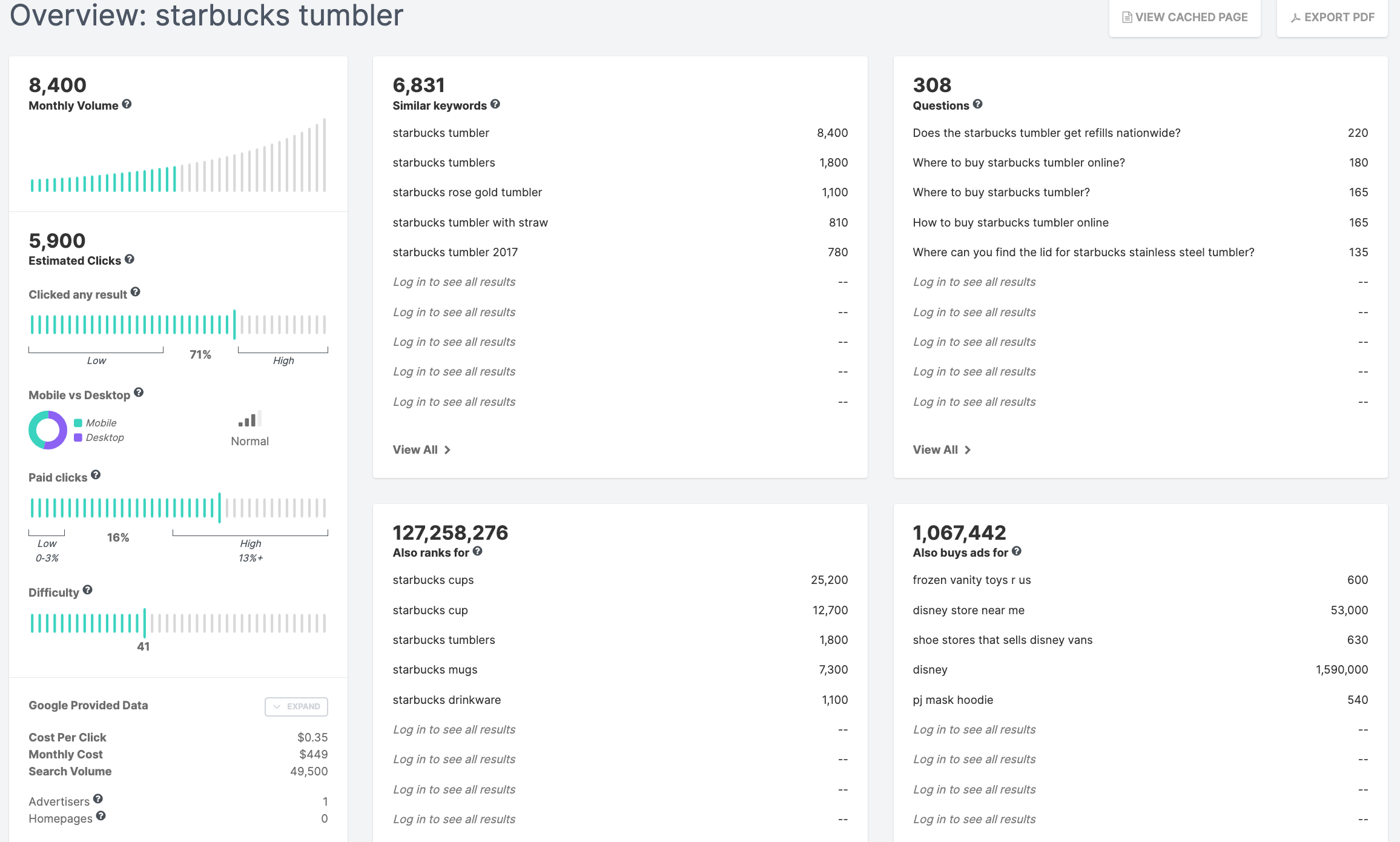
Figure 1.2
In figure 1.2 which shows keyword research using spyfu.com, we can find the CPC, or cost-per-click, for “Starbucks tumbler”. We can also identify that the second most popular question users ask in relation to Starbucks’ tumblers is “Where to buy Starbucks tumbler online?”. “Online” could be a potentially valuable keyword to include in our optimization efforts.
The site also shows other keywords with the highest bids in other PPC ads, which in this example all have Disney themes. This gives more insight into the appropriate content direction for our audience.
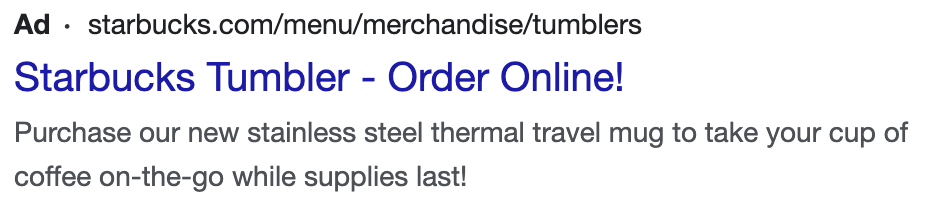
Figure 1.3
Based on our example, here’s a recommended text ad (figure 1.3) using the Google Ads Preview tool to improve conversions for the Starbucks tumbler using SEO strategies:. Note that we have used each of the aforementioned keywords in our ad. In some cases, you may even consider using a URL shortener website to condense longer URL links.
Choosing the Appropriate PPC Strategy
Now that we have optimized our content for organic searches, we can consider which PPC strategy is best suited for our predicament and will deliver our desired results. We know that people were seeing us, they just didn’t like or couldn’t relate to what they saw. Now that we have relevant content, we may consider using either the cost-per-click or cost-per-mille (CPM) bidding strategies for as low as $0.35 per click (see figure 1.2) to increase visibility and impressions and get the most bang for our buck.
This may be a better option than cost-per-acquisition (CPA), which can be fairly expensive at $5 per acquisition, however, Starbucks could consider using CPA if they would rather have definite conversions and ROI in return for limited conversions, depending on the needs of the business.
To conclude, PPC and SEO strategies work hand in hand to deliver the best results for both marketers and those searching for products. It would be of great benefit to marketers to include PPC and SEO strategies in their digital marketing ad campaigns for better conversions.

Kimberly Eugene - Content Marketing Specialist
Owner of PRTYNVRNDS LLC
Futuristic | Strategic | Developer | Positivity | Relator
prtynvrnds.business.blog
References:
Competitor keyword research tools for google ADS PPC & seo. SpyFu. (n.d.). Retrieved May 5, 2023, from https://www.spyfu.com/keyword/overview?query=starbucks+tumbler
Google. (n.d.). About negative keywords. Google Ads Help. Retrieved May 5, 2023, from https://support.google.com/google-ads/answer/2453972?hl=en
Starbucks®. Starbucks Coffee Company. (n.d.). Retrieved May 5, 2023, from https://www.starbucks.com/menu/merchandise/tumblers